
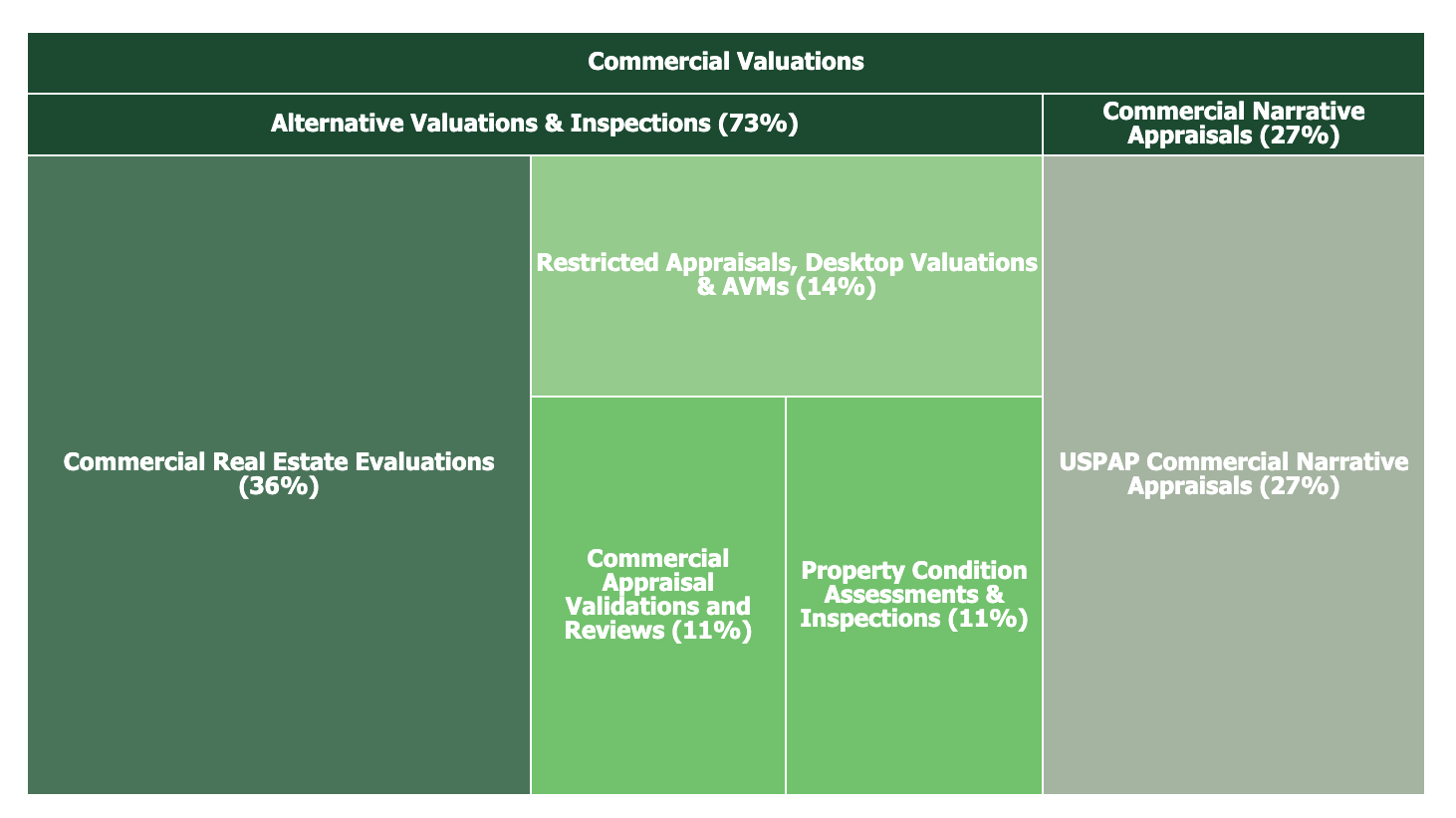
Every year, lenders, investors, loan servicers, and special asset groups order millions of commercial valuations and related assignments to support new lending, refinancing, loan renewals, portfolio management, regulatory compliance, and distressed asset management.
The market is highly fragmented across banks, credit unions, life insurance companies, CMBS lenders, debt funds, government agencies, appraisal management companies, valuation firms, and independent appraisers.
By combining commercial mortgage origination volumes, outstanding loan balances, servicing activity, and regulatory requirements, it is possible to estimate the size of the commercial valuation market with a high degree of confidence.
Commercial Valuations & Loan Lifecycle
Commercial properties require updated valuations when a borrower refinances an existing loan, requests a maturity extension, modifies loan terms, renews a credit facility, or enters a workout or special servicing process.
Financial institutions also perform periodic collateral valuations as part of portfolio risk management and regulatory compliance. Construction lenders require inspections and draw reviews throughout a project’s development, while CMBS servicers monitor collateral supporting securitized loans.
Commercial valuations demand is generated by a broad range of lending and asset management activities rather than by new originations alone.
Commercial Valuation Activity
Although volumes vary with market conditions, interest rates, and transaction activity, the following estimates illustrate the scale of the annual U.S. commercial valuations market.
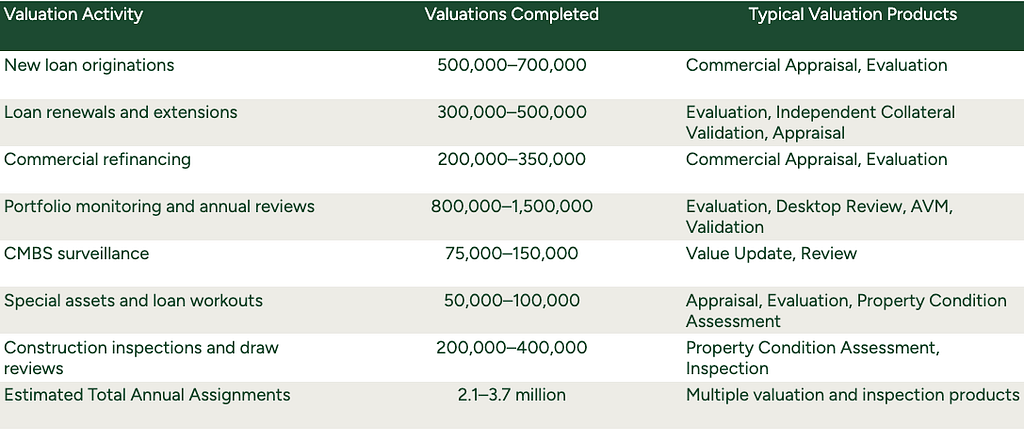
The U.S. market generates approximately 2.5 to 3.0 million commercial valuations and related assignments each year.
Commercial Valuations Drivers
There are three main drivers for commercial valuations:
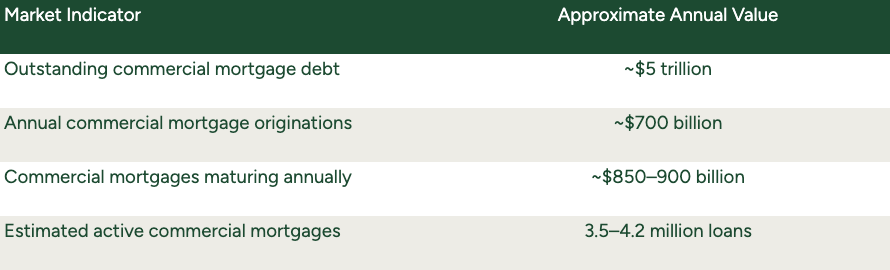
First, commercial real estate represents one of the largest secured lending markets in the United States. Outstanding commercial and multifamily mortgage debt totals approximately $5 trillion, spread across millions of active loans held by banks, insurance companies, pension funds, government-sponsored enterprises, CMBS investors, and private lenders.
Second, loan portfolios are constantly evolving. Every year, hundreds of billions of dollars of commercial mortgages mature and require refinancing, extension, modification, or payoff. Even loans that remain current often undergo periodic collateral reviews to satisfy internal credit policies or regulatory expectations.
Third and finally, commercial properties themselves are dynamic assets. Market conditions, occupancy, rental income, capitalization rates, tenant quality, construction activity, and local economic conditions can all influence collateral value over time. These changing conditions create ongoing demand for updated valuation information.
Estimated Commercial Lending Activity
The following market statistics outline the commercial valuations demand.
Every new commercial loan generally requires either a commercial appraisal or a commercial evaluation depending on the institution’s policies, transaction risk, loan size, and applicable regulations.
Existing loans may require additional collateral support throughout their servicing lives, particularly when market conditions change or borrowers request modifications.
Commercial Valuations is Broad
The commercial valuation market has expanded significantly over the past two decades. While full USPAP appraisals remain essential for many transactions, lenders increasingly use a variety of collateral products that are tailored to the specific purpose of the assignment.
These products include commercial evaluations, desktop reviews, automated valuation models (AVMs), commercial appraisal validations, broker price opinions where appropriate, property condition inspections, and construction inspections.
The appropriate valuation product depends on factors such as transaction risk, loan size, property complexity, regulatory requirements, and the lender’s internal credit policies.
Commercial Valuations Volumes
Using the estimated 2.5 to 3.0 million annual commercial valuation assignments, the following table illustrates how activity is distributed across major product categories.
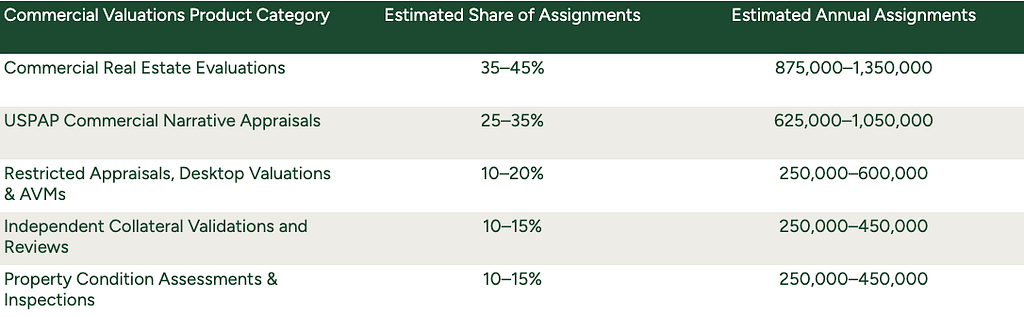
It is important to note that these categories are not mutually exclusive. A single commercial loan may require several different collateral products over its life.
For example, a property may receive a USPAP appraisal at origination, a property condition assessment during underwriting, an evaluation at loan renewal, and an independent collateral validation during servicing. The figures therefore represent the approximate share of annual assignment activity by product type rather than a strict allocation of unique loans.
Existing Portfolios Generate the Greatest Demand
Commercial loan servicing generate the greatest share of commercial valuation orders.
Financial institutions continually monitor collateral supporting performing loans, particularly as loans approach maturity or borrowers request extensions. Banks also perform periodic portfolio reviews, monitor concentrations of credit risk, and evaluate collateral supporting criticized or classified assets.
Special servicing organizations, CMBS servicers, and asset managers likewise require updated collateral information throughout the life of a loan. These recurring assignments create a steady source of valuation activity that is less dependent on interest rate cycles than new loan production.
Future of Commercial Valuations
Commercial real estate valuations are no longer a one-time event completed only at loan origination. They have become an ongoing component of credit risk management throughout the commercial lending lifecycle.
An estimated 2.5 to 3.0 million commercial valuation-related assignments are performed annually across originations, refinancings, renewals, portfolio monitoring, servicing, construction lending, and special asset management. These assignments encompass a broad range of products designed to meet varying transaction types, risk profiles, and regulatory requirements.
Understanding the size and diversity of this market provides valuable context for lenders, investors, and valuation professionals as commercial real estate finance continues to evolve. In the next article in this series, we examine the growing role of commercial real estate evaluations, including where they fit within the lending process, how they differ from traditional appraisals, and why they have become an essential tool for modern collateral risk management.